The Establishment Division of Pakistan’s Cabinet Secretariat has issued a fresh Office Memorandum that finally settles a question that had left thousands of grieving families in bureaucratic limbo for nearly two years: what happens to job applications filed by the widows, sons, and daughters of federal government employees who died in service, when the death occurred before a landmark Supreme Court ruling reshaped the rules?
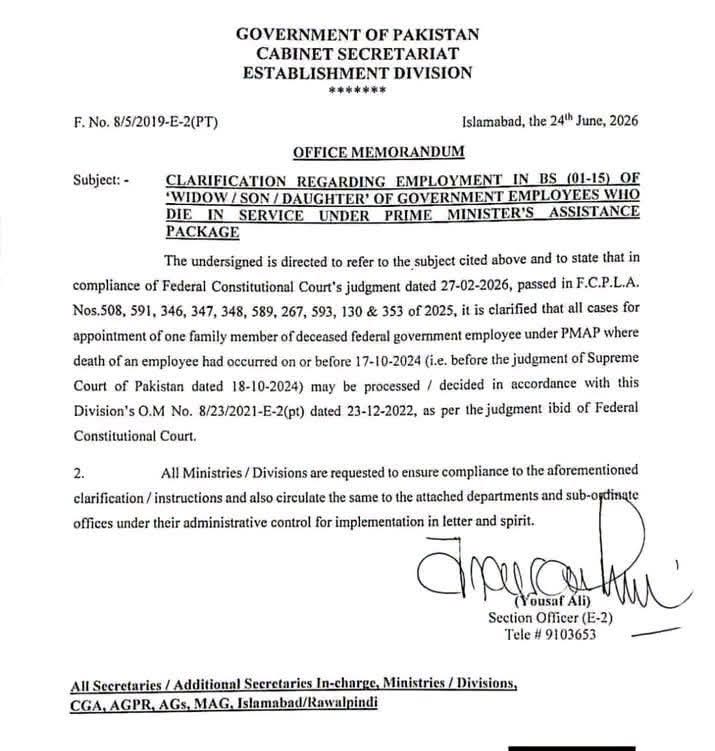
The memorandum, F. No. 8/5/2019-E-2(PT), dated 24th June 2026, was issued from Islamabad and signed by Section Officer (E-2) Yousaf Ali. Its subject line is dense with bureaucratic language, but its real-world impact is significant: it clarifies how pending appointment cases under the Prime Minister’s Assistance Package (PMAP) should now be decided, following a judgment of the newly established Federal Constitutional Court.
What Is the Prime Minister’s Assistance Package?
PMAP is a long-standing welfare scheme under which the federal government offers employment to one eligible family member — typically a widow, son, or daughter — of a government employee who dies while still in service. The scheme has existed in various forms since the mid-2000s and has been revised multiple times, most recently through an Establishment Division policy dated 23rd December 2022, which replaced the earlier contract-based appointment model with regular appointment for posts in Basic Pay Scale (BS) 01 to 15, processed under the Civil Servants (Appointment, Promotion and Transfer) Rules, 1973, with the usual advertisement requirement relaxed.
For many families who lose their primary breadwinner unexpectedly, PMAP has functioned as a crucial safety net, offering not just financial support but a guaranteed livelihood at a time of personal crisis.
The 2024 Supreme Court Ruling That Upended the Scheme
The current clarification cannot be understood without going back to a consequential judgment delivered by the Supreme Court of Pakistan on 18th October 2024, in Civil Petition No. 3390 of 2021 (General Post Office, Islamabad & others vs. Muhammad Jalal). In that ruling, the Court held that appointments made without open advertisement, competition, and merit-based selection — including the automatic job entitlements granted to the families of deceased or permanently disabled civil servants — were discriminatory and inconsistent with the principles of equality enshrined in the Constitution.
Following that judgment, the Establishment Division issued an Office Memorandum on 7th February 2025 formally withdrawing the PMAP employment provision for future in-service deaths. Appointments already completed before the ruling were protected and remained unaffected, but the door was effectively closed for new cases going forward.
The problem was that the ruling created a large and painful gray area. What about families whose loved ones had died before the October 2024 judgment, but whose appointment applications were still pending, unprocessed, or stuck somewhere in the system when the withdrawal order came into effect? These families had lost a family member under the old rules, with a legitimate expectation of a job under PMAP, only to find their applications frozen indefinitely by a policy shift that was never meant to apply to them retroactively.

Enter the Federal Constitutional Court
Pakistan’s newly created Federal Constitutional Court took up this very question. In a judgment dated 27th February 2026 — delivered across a batch of connected petitions (F.C.P.L.A. Nos. 508, 591, 346, 347, 348, 589, 267, 593, 130, and 353 of 2025) — the Court addressed the fate of these pending, pre-2024 cases.
The new Office Memorandum of 24th June 2026 is the Establishment Division’s formal response to that judgment. It clarifies, in plain terms, that:
- All PMAP appointment cases where the employee’s death occurred on or before 17th October 2024 — that is, the day before the Supreme Court’s judgment was pronounced — may now be processed and decided in accordance with the December 2022 policy.
- This effectively restores the pathway to regular appointment (BS 01–15) for the family members of employees who died before the cut-off date, even though their cases had been left pending amid the 2024–2025 policy freeze.
- All Ministries and Divisions have been directed to ensure compliance and to circulate the clarification down to their attached departments and subordinate offices for implementation “in letter and spirit.”
In short, the ruling draws a clear line: deaths on or before 17th October 2024 fall under the old, more generous PMAP rules; deaths after that date fall under the post-judgment regime, where automatic employment is no longer available.
Ripple Effects Across Departments
The clarification has already begun trickling down through federal institutions. The Federal Board of Revenue (FBR), for instance, issued a circular on 3rd July 2026 forwarding the Establishment Division’s clarification to Chief Collectors, Directors General, Collectors, and Directors of Customs, instructing them to decide all pending cases accordingly and report progress back to the Board.
Notably, the broader policy package also includes a one-time concession for employees who were appointed on a contractual basis under the earlier PMAP-2006 and PMAP-2015 schemes and are still serving: their positions are to be regularised with immediate effect. This addresses a separate but related grievance — contract employees who had been in a kind of professional limbo for years, uncertain whether their jobs would ever convert to permanent, regular positions.
Why This Matters
For the families affected, this memorandum is more than an administrative technicality — it is the resolution of months, in some cases years, of uncertainty following the death of a loved one. Losing a family member who was the primary earner is difficult enough; having a promised job opportunity suspended indefinitely by a policy change compounds that hardship considerably.
At the same time, the episode illustrates the delicate balancing act facing Pakistan’s civil service framework: the Supreme Court’s 2024 judgment was rooted in sound constitutional principles — merit, equal opportunity, and non-discrimination in public employment — while the Federal Constitutional Court’s 2026 clarification tries to ensure that families who had a legitimate claim under the old rules are not unfairly caught in the crossfire of a policy reform that was never intended to apply to them.
What Affected Families Should Do Next
If you or someone in your family has a pending PMAP appointment application tied to an employee who died on or before 17th October 2024, it would be worth:
- Confirming with the relevant Ministry or Division that your case file has been located and is being processed under the December 2022 policy guidelines.
- Keeping copies of the death certificate, service record, and any prior correspondence regarding the PMAP application.
- Following up in writing (and retaining proof of submission) if there is no movement within a reasonable time, referencing this Office Memorandum (F. No. 8/5/2019-E-2(PT) dated 24th June 2026) directly.
As with most bureaucratic processes in Pakistan, implementation across hundreds of departments and subordinate offices may not be instantaneous or uniform. Families are advised to stay in regular contact with their department’s establishment or HR section and to escalate through the Federal Ombudsman’s office if delays persist despite this clarification.